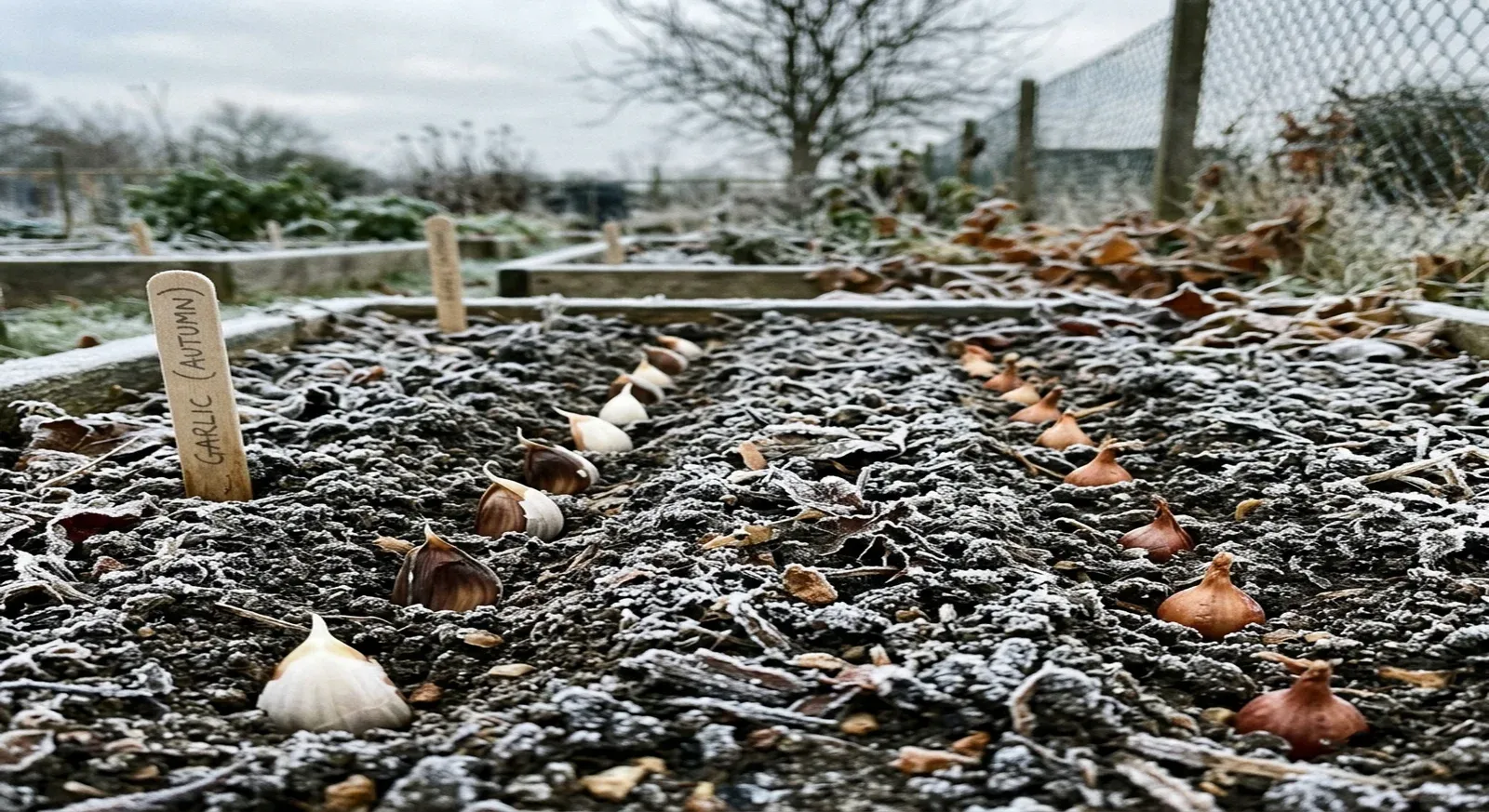
Vernalization is the cold requirement biennial vegetables need before they can flower, bulb, or produce a harvestable crop. The crops most affected include onion, leek, garlic, carrot, beetroot, chard, celery, celeriac, cabbage, cauliflower, broccoli, kale, parsnip, and broad bean. When a susceptible plant receives sufficient cold and then warms up, it bolts: it diverts energy into a flowering stalk rather than forming a head, root, or bulb.
Biennial vegetables complete their life cycle across two growing seasons. In the first season they build vegetative mass: roots, leaves, stems, or bulbs. In the second season they flower and set seed. Vernalization is the cold signal that authorises that transition. The plant measures accumulated cold time across weeks, not just overnight lows. Once the threshold is crossed, warming temperatures in spring or early summer trigger the shift to reproductive growth. Without sufficient cold, most biennial crops stay in a prolonged vegetative state and never flower. With sufficient cold at the wrong time, the plant bolts before producing anything edible. What makes vernalization tricky is that the critical variable is not just temperature, but the size and developmental stage of the plant when the cold arrives.
The sowing implications are direct. A seedling that germinates in late winter and sits through a cold March can accumulate enough vernalization to bolt in May before it has ever formed a usable root, head, or stalk. The threshold is not freezing. For most crops in this table the effective range falls between 6°C and 13°C (43°F and 55°F), which covers typical early spring temperatures across most temperate climates. The practical rule for susceptible crops is to sow after the coldest weather has passed, and to take particular care with early sowings under glass, where seedlings may be transplanted out into cool spring soil before the plant is large enough to buffer the cold exposure.
Vernalization Requirements by Crop
The table below lists temperature thresholds, minimum cold duration, the expected consequence of premature vernalization, and the confidence level for each row. Confidence reflects how directly the data comes from a primary source for this specific crop. High means peer-reviewed data with quantitative thresholds directly applicable to this crop. Medium means strong evidence exists but the primary papers were paywalled or accessed only by abstract, or data from a closely related variety was applied. Low means no crop-specific quantitative primary source was found and data is extrapolated from family-level analogies.
| Crop | Temp Threshold | Min Days | Consequence | Confidence | Notes |
|---|---|---|---|---|---|
| Onion | ≤10°C (50°F) | 56 | Bolting: scape splits bulb neck, bulb becomes inedible | Medium | Pseudostem ≥6 mm required before cold sensitivity begins; red onions more prone than yellow or white cultivars |
| Leek | Unclear | Unclear | Bolting: flower stalk emerges, stem hardens, sheath opens | Low | Devernalization threshold: ≤17°C (63°F); induction temperature and minimum days not found in accessed sources |
| Garlic | ≤10°C (50°F) | 40 | Poor bulbing: single-clove rounds, reduced clove count and yield | Medium | Acts on stored clove or growing plant; no plant-size juvenility threshold; over-vernalization increases scape production in softneck types |
| Cabbage | ≤10°C (50°F) | 28 | Bolting: head splits or fails to form; plant goes to seed stalk | Medium | Cold sensitivity begins at stem ≥5 mm or 7–9 leaves; optimal vernalization temperature 4–10°C |
| Cauliflower | ≤10°C (50°F) | 35 | Premature curd initiation: loose, ricey, or buttoned curds before a marketable head forms | Medium | Juvenile phase 5–8 weeks (5–7 leaves); winter types need extended cold; summer types more sensitive |
| Broccoli | ≤10°C (50°F) | 42 | Scattered small florets before central head forms; purple sprouting broccoli fails to produce lateral shoots | Medium | Calabrese (annual type) has minimal cold requirement; purple sprouting broccoli needs 6–10 weeks at 5°C; large cultivar variation |
| Kale | ≤10°C (50°F) | 28 | Bolting: flowering stalks emerge, leaves become tough and bitter | Low | (low confidence, family analogy only); no kale-specific quantitative primary source found; kale less economically affected than heading brassicas |
| Celery | ≤10°C (50°F) | 42 | Bolting: stalks become hollow, pithy, bitter, and inedible | Medium | Requires 6–8 true leaves before cold sensitivity begins; 4–9°C is the optimal induction range; source is practitioner-level (Seed Savers Exchange, consistent with Ramin and Atherton 1991 abstracts) |
| Celeriac | ≤10°C (50°F) | 42 | Root fails to enlarge: small, fibrous, unusable swollen hypocotyl | Medium | Same species as celery (Apium graveolens); more susceptible to bolting than celery per MSU Extension |
| Carrot | ≤6.5°C (44°F) | 14 | Bolting: root forks and becomes woody; tall umbellifer seed stalk produced | Medium | Topt = 6.5°C; induction ends above Tmax = 16.0°C; requires 8–12 initiated leaves; 14 days is a practical minimum |
| Parsnip | ≤9°C (48°F) | 14 | Bolting: root becomes woody and inedible; seed stalk produced | Low | (low confidence, family analogy only); carrot (Apiaceae) used as best available proxy; typically overwinters in ground without bolting issues |
| Beetroot | ≤13°C (55°F) | Unclear | Bolting: root becomes woody; yield reduced over 50% in severe cases | Medium | Hours-based model (0–13°C effective range); governed by B locus; bolt-resistant cultivar Boltardy has a higher threshold |
| Chard | ≤13°C (55°F) | Unclear | Bolting: leaf production stops; leaves become tough and bitter | Medium | Same species as beetroot (Beta vulgaris); B locus genetics apply; days-at-temperature primary data not directly accessed |
| Broad bean | ≤9°C (48°F) | 30 | Spring-sown: later flowering and reduced yield; winter types without adequate cold: failure to flower | Medium | Seed can be vernalized directly; no plant-size juvenility threshold; spring-sown and overwinter types differ fundamentally |
Practical Notes
The most important variable in the table above is not temperature or duration in isolation: it is plant size at the time of cold exposure. For onions and cabbages, plants must reach a minimum size before they can perceive cold at all. Onion sets must have a pseudostem of at least 6 mm in diameter. Cabbage needs to have reached 7 to 9 leaves or a stem of 5 mm. Below those thresholds, cold passes without triggering the vernalization clock. This is why tiny seedlings sown under glass in January often do not bolt when moved outside in March: they are still juvenile and cold-insensitive. The risk appears once plants pass that threshold, which typically happens during April and May sowings that coincide with the last cold spells of spring.
Sowing timing is the main tool for managing unwanted vernalization. For crops like beetroot, chard, onions, and celery, the RHS and extension services consistently recommend waiting until the coldest weather has passed before sowing outdoors. In the UK this typically means waiting until late March to April for beetroot and chard, and not transplanting onion sets before conditions are reliably above 10°C. For celery and celeriac, which need 6 to 8 true leaves before cold sensitivity begins, early indoor sowings in February are safe as long as transplanting is delayed until the plant is large enough and the weather is warm enough. The combination of a large plant and cold outdoor conditions in May is the scenario most likely to cause bolting.
Bolt-resistant varieties exist for the most economically sensitive crops. Beetroot cultivar Boltardy was bred specifically for early sowing and has a higher vernalization threshold than most alternatives. Among onions, yellow and white storage types tend to be less prone to bolting than red onions. For brassicas, seed catalogues indicate cold tolerance more clearly than bolting resistance, but spring cabbage types marketed for overwintering are specifically selected to vernalize over winter and produce heads in spring without bolting early. Choosing varieties appropriate to the sowing window makes more difference than trying to manage temperatures in most home garden situations.
Deliberate vernalization is equally important for crops where cold is the target, not the hazard. Garlic is the clearest example. Hardneck types require a genuine cold period to separate cloves and produce full bulbs. Autumn planting puts the cloves into cold winter soil, and vernalization proceeds naturally over November through February. Spring-planted garlic, which misses the winter, needs pre-planting chilling at 3 to 5°C for 40 to 60 days before going in the ground; skipping this step produces single-clove rounds rather than multi-clove bulbs. Overwintered broad beans similarly use natural vernalization to accelerate flowering and produce more pods from a shorter growing season than spring-sown equivalents. For these crops, the cold is not a risk to manage: it is a requirement to satisfy.
Methodology Note
The confidence levels in the table reflect three distinct situations. High confidence means a peer-reviewed primary source with quantitative temperature and duration data for this specific crop was directly accessed and read in full or near-full. No crops currently meet this strict definition — the closest are carrot (Atherton et al. 1990 abstract, full tables paywalled) and cabbage (Bute et al. 2022 and McCormack 2009).
Medium confidence means strong evidence exists but with at least one of the following limitations: the primary quantitative paper was paywalled and accessed only by abstract or search snippet; data from a closely related variety or cultivar group was applied to the crop in question; or the temperature threshold was confirmed but the minimum-days figure came from a secondary practitioner source rather than a controlled experiment. Onion, garlic, broccoli, celeriac, beetroot, chard, cauliflower, and broad bean are in this group.
Low confidence means no crop-specific quantitative primary source was directly accessed. Leek minimum days and induction temperature are not found in the accessed literature: the ≤17°C figure in the table is a devernalization threshold (the temperature above which early induction is reversed) from Gray and Steckel (1990), not an induction threshold. Parsnip and kale values are extrapolated from general Apiaceae and Brassicaceae family patterns respectively, with no direct primary source for either crop. These rows should be treated as indicative only.
Several quantitative primary sources that would raise confidence for onion (Brewster 1987), carrot (Atherton et al. 1990 full tables), cauliflower (Wurr et al. 1993), broccoli (Wurr et al. 1995), leek (Booij 1989), celery (Ramin and Atherton 1991 full paper), beetroot and chard (Chroboczek 1934), broad bean (Ellis et al. 1988), garlic (Wu et al. 2015), and parsnip (Baskin and Baskin 1979) are in a list for future access. The table will be updated as those papers are retrieved.
Beetroot and chard minimum days are listed as Unclear because the best available model for both crops uses accumulated hours below 13°C rather than a simple day count. A days figure derived from that model would be misleading without specifying the average temperature assumed. Leek minimum days are Unclear for a different reason: the induction threshold itself was not found in the accessed sources, so a minimum duration cannot be meaningfully stated.
Sources
- Atherton JG, Craigon J, Basher EA (1990). “Flowering and bolting in carrot. I. Juvenility, cardinal temperatures and thermal times for vernalization.” Journal of Horticultural Science 65(4):423–429. doi.org/10.1080/00221589.1990.11516075
- Bute IS et al. (2022). Vernalization and flowering review for Brassica oleracea. Lucrări Ştiinţifice Seria Horticultură 65(2)/2022. uaiasi.ro/revista_horti/files/Nr2_2022/vol%2065_2_2022%20(11).pdf
- Ellis RH, Roberts EH, Summerfield RJ (1988). “Photothermal Time for Flowering in Faba Bean (Vicia faba) and the Analysis of Potential Vernalization Responses.” Annals of Botany 61(1):73–82. doi.org/10.1093/oxfordjournals.aob.a087532
- Gray D, Steckel JRA (1990). “Inflorescence initiation and development in leek.” Acta Horticulturae 267. doi.org/10.17660/ActaHortic.1990.267.29
- McCormack JH (2009). Brassica Seed Production. Organic Seed Alliance. Open-access manual, brassica vernalization section directly read.
- MSU Extension (2023). “Bolting in spring vegetables.” Michigan State University Extension. canr.msu.edu/news/bolting-in-spring-vegetables
- Ramin AA, Atherton JG (1991). “Manipulation of bolting and flowering in celery. II. Juvenility.” Journal of Horticultural Science 66(6):709–717. doi.org/10.1080/00221589.1991.11516203
- Scielo / Pesquisa Agropecuária Tropical (2023). Garlic vernalization: clove chilling at 3–5°C for 40–60 days. scielo.br/j/cagro/a/9D6MtYJF3cfPNdpphTkBX3H/
- Seed Savers Exchange / Mother Earth News (2015). The Seed Garden. Celery and celeriac vernalization section. Accessed via motherearthnews.com/organic-gardening/celery-seeds-ze0z1510zbay/
- Tallis A (2012). Vernalization in Purple Sprouting Broccoli. MPhil thesis, University of East Anglia. ueaeprints.uea.ac.uk/id/eprint/39152/1/2012TallisAMPhil.pdf
- Tognoni F et al. (1993). “Flower induction in celeriac (Apium graveolens L. var. rapaceum).” Scientia Horticulturae 53(3–4). doi.org/10.1016/0304-4238(93)90034-N
- Vleeshouwers LM et al. (2026). Sugar beet vernalization model. PLOS ONE. doi.org/10.1371/journal.pone.0339856
- Brewster JL (1987). “Vernalization in the onion: a quantitative approach.” In: Atherton JG (Ed.) The Manipulation of Flowering. Butterworths, London, pp. 171–183.
Cite This Data
Leaftide’s original compilation, article text, and reference table are published under Creative Commons Attribution 4.0 (CC BY 4.0). The underlying data in each row is attributed to its respective primary source as listed above.
How to cite: Leaftide (2026). “Vernalization Requirements for Vegetables: Temperature and Duration by Crop.” Retrieved from https://leaftide.com/learn/vernalization-requirements/. Data compiled from Atherton et al. (1990), Bute et al. (2022), McCormack (2009), Tallis (2012), Ellis et al. (1988), Gray and Steckel (1990), Seed Savers Exchange (2015), and other sources as listed above.
Last updated: 27 September 2026.
For related reference data, see the frost damage temperatures guide and the chill hours guide.