The holiday problem
Every summer I faced the same question: can I go away in the first week of August, or will that be exactly when the tomatoes start ripening? The seed packet said “ready in 70 days” but that number never matched reality. Some years the harvest came early. Other years it dragged into September. I had no way to predict it.
I wanted to plan around my garden, not the other way around. But without knowing when things would actually be ready, I was always guessing.
What the seed packet gets wrong
The “days to harvest” on a seed packet is an average, measured under ideal conditions that probably do not match your garden. It does not account for your local climate, the weather this season, or whether you started seeds indoors or sowed directly outside.
Two gardeners planting the same variety on the same date can have harvest times weeks apart, depending on where they live and how warm their growing season is. The seed packet cannot tell you that.
How predictions actually work
Leaftide uses something called growing degree days to predict when each stage of growth will happen. Instead of counting calendar days, it counts accumulated warmth.
The idea is simple: plants need a certain amount of heat to move from one stage to the next. On a warm day, they accumulate more. On a cool day, less. By adding up the warmth your location typically receives, the system can estimate when germination, flowering, and harvest are likely to happen.
This means the prediction adjusts to your climate. A gardener in the south of England will see earlier dates than someone in Scotland, even for the same variety planted on the same day. And if you start seeds indoors with heat, that shows up in the prediction too.
What I see now
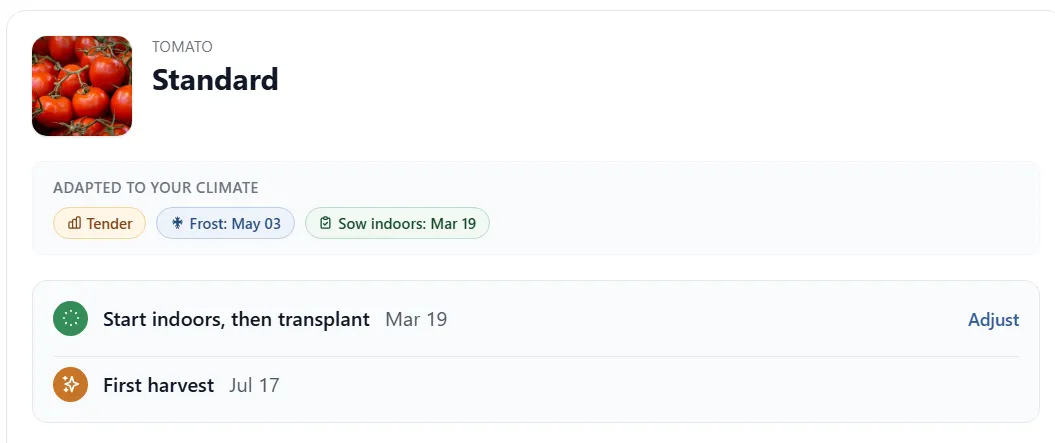
When I plan a tomato crop, I can see a predicted harvest window before I even sow the seeds. If I adjust my sowing date or change how I start them, the prediction shifts. I can play with the timing until I find a plan that works around my calendar.
It is not perfect. Weather varies year to year, and predictions are still estimates. But they are estimates based on real data, not a generic number printed on a packet. That makes a real difference when I am trying to decide whether to book that August trip.
What this means in practice
I still check the forecast and watch the plants. But I no longer feel like I am guessing in the dark. The predictions give me a starting point, and the rest I adjust as the season unfolds.
Calculate harvest timing with the Crop Timeline Calculator.